
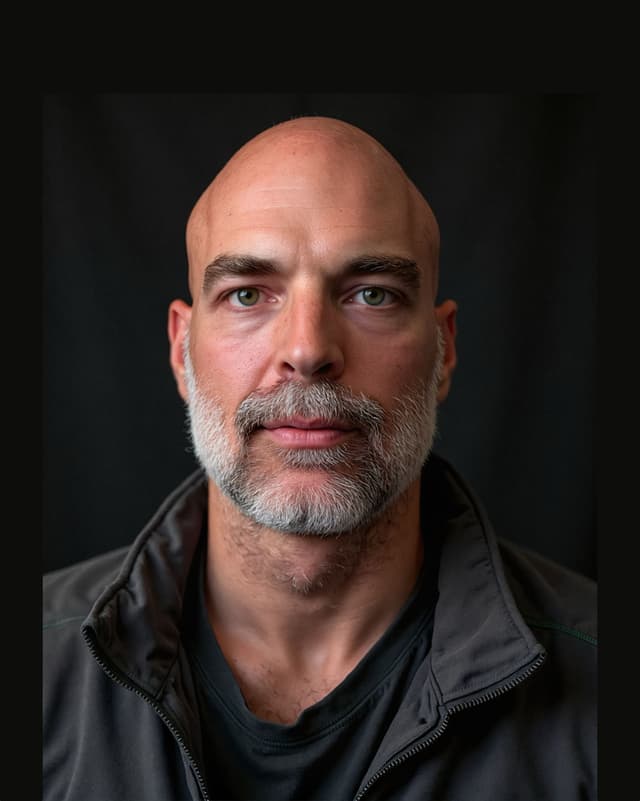
I See the World Differently. So Do They.
This practice is built on a single belief: the unique wiring of a truly individual mind is not a deficit to be managed. It is an edge.
My job is to help students see that. To give them the tools and systems to turn intense focus, pattern-matching, and boundless curiosity from liabilities in a standard classroom into assets in the real world.
It Started With a Nintendo
When I was seven, my first thought was, “This is amazing.” My second: “But how the hell does this work?” No one could answer — not really. All I saw was a system, a code, a mystery waiting to be solved. That question took me all the way through a degree in computer architecture.
When adults said, “It's too complicated,” I heard a casual dismissal of curiosity. I became the person I wish I'd met then: someone who explains how things work, who meets every question with respect, and who never, ever talks down.
Complex ideas aren't hard to understand. They're just rarely explained with clarity.
The Path That Led Here
The questions led me to UT Austin, where I finished at the top of Yale Patt's computer architecture course — a class taught by a legend who then invited me to work alongside his PhD students for three years. From there into National Instruments' engineering leadership program, then running the Bay Area as their youngest district manager.
I left to build my own investment firm. Passed all three CFA exams on the first attempt. Joined a cybersecurity startup as employee number three and built their sales engine into an eight-figure operation before McKinsey came calling. Then Microsoft recruited me for a director role — the job everyone wanted.
And I walked away.
Not because the work was hard. Because it was empty. Every rung confirmed the same thing: I was built to build people, not products. The question that started with a Nintendo had become something larger — how do you take the way a mind works and turn it into an advantage?
What 3,000 Hours Taught Me
At Fusion Academy — a school built on one-to-one mentorship — I recorded over 3,000 hours of my sessions. Then I spent nearly another 1,000 hours building AI models to analyze every transcript. Not for marketing. For the work itself.
After every session, I review the recording. I run the transcript through models I built to catch what I missed — where the student's energy dropped, where their reasoning went sideways, where they needed another thirty seconds I didn't give them. Then I adjust the next session plan.
Here is what the patterns taught me:
The students who struggle most are almost never struggling with the material. They're struggling with what school taught them about themselves. A kid who has been told — through grades, through grouping, through the quiet exclusion of being “too much” or “not enough” — that their mind is a problem? That kid doesn't need a better explanation of quadratic functions. They need someone to show them that the way they think is not broken. It's just untranslated.
When a student says, “I'm not good at this,” I add one word: “...yet.”
That's not a feel-good platitude. It's a complete reframing of what's possible. And it only works inside a space where the student trusts you enough to stop performing and start being honest about what they don't understand.
What I Actually Build
My work is not a service. It's a partnership — and a calling.
Lasting growth only happens where there is true safety. Every student I work with enters a space built on honesty — where they can be wrong, question everything, and know they are respected for it. I tell them the truth. I expect them to tell me the truth. Inside that trust, something remarkable happens: they stop performing and start becoming.
True transformation is uncomfortable, and the work is long-term. I don't offer quick fixes. I offer a mirror, a framework, and the patience to let a young person discover what they're actually capable of.
Your word is your credit rating for life. That's one of the first things my students learn. Not because I lecture about it — because I model it.
My Legacy Is My Students
I'm done climbing ladders that don't matter. This practice exists to change the trajectories of the quietly brilliant, the curious explorers, and the neurodivergent kids who, like me, have minds that don't fit the mold.